

A Central Coast Homeowner’s Guide from Santa Cruz to Monterey
When people picture a house burning in a wildfire, they picture a wall of flame. But most homes that burn are lost to something much smaller. A CAL FIRE defensible-space official has said that somewhere between 60 and 90 percent of homes lost to fire burn because of embers, the glowing bits that ride the wind ahead of the fire front.
Embers don’t need an open window. They need a gap. And on most Central Coast homes, the biggest gap-prone opening in the whole house is the garage door. That’s also the room where we keep gas cans, paint, cardboard, and the car.
Here’s what changed this year, what California’s code now says about garage door gaps, a quick test you can do this weekend, and the fixes that actually work in our salty, foggy climate.
Why This Matters More in 2026 Than It Did Before
For years, many coastal homeowners assumed wildfire was a mountain problem. The maps used to agree. The previous Local Responsibility Area fire hazard map, released in 2007, didn’t include any land in Santa Cruz County.
The 2025 maps changed that. According to Santa Cruz Local’s reporting on the CAL FIRE maps:
- High hazard areas now include parts of Scotts Valley, La Selva, the Aptos Hills, and the North Coast.
- Moderate hazard areas include Live Oak, New Brighton, and the edges of the City of Santa Cruz.
- Very High hazard areas appear in South County near Harkins Slough and Johnsen Lane.
- In the state-protected rural areas, Very High zones sit near Boulder Creek and along Freedom Boulevard, with Moderate zones in Felton, Ben Lomond, and Soquel.
On the Monterey side, the City of Monterey and the Monterey County Regional Fire District both received updated hazard maps on March 10, 2025, with 120 days to adopt them.
None of this is abstract here. The 2020 CZU Lightning Complex burned 86,509 acres and destroyed 1,490 structures in the Santa Cruz Mountains and San Mateo County.
The building rules changed too.
California now has a standalone Wildland-Urban Interface Code (Title 24, Part 7), which took effect January 1, 2026. It pulls the old fire-zone building rules into one book, and it has two lines aimed squarely at your garage.
The Rule in Plain English: 1/8 of an Inch
Section 504.9.2 of the 2025 California Wildland-Urban Interface Code says exterior garage doors must keep embers out. It does that by limiting the gap between the door and the opening to no more than 1/8 inch, and that limit applies at the bottom, the sides, and the top. (See the code text summarized here.)
The code allows three ways to control those gaps, alone or combined:
- Weatherstripping made of qualifying material. More on what “qualifying” means below.
- Door overlaps onto the jambs and header, so the door itself covers the gap.
- Metal flashing covering the garage door jambs and header.
The section right before it, 504.9.1, also requires automatic openers on residential vehicle doors to have a battery backup function. California already required battery backup on newly installed openers, so this one won’t surprise anyone who has replaced an opener recently.
The detail most guides skip: not all weatherstripping qualifies.
To count under the code, the seal material has to pass two tests.
- First, its tensile strength is measured before and after 2,000 hours of accelerated weathering (ASTM G155), and the two results can’t differ by more than 10 percent.
- Second, it has to earn a UL 94 V-2 flammability rating or better.
Most bottom seals on a hardware store hook don’t say anything about either test on the package. To add to the confusion, the code’s voluntary home-hardening appendix mentions UL Standard 10C for garage door weatherstripping instead. If you’re doing this for a permit or an inspection, ask for the manufacturer’s test documentation and ask your building department which standard they want to see.
The Two-Quarter Test (Do This Weekend)
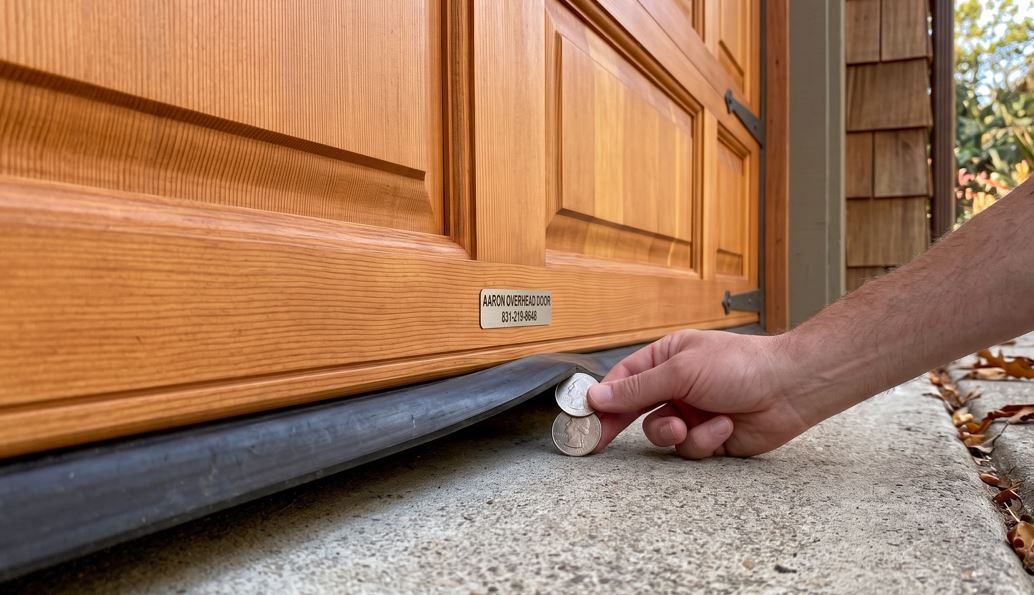
You don’t need a feeler gauge to find out if your door has a problem. You need two quarters.
A U.S. quarter is about 1.75 mm thick. Stack two and you get about 3.5 mm, just a hair over 1/8 inch (3.2 mm). If two stacked quarters slide through a gap anywhere around your closed door, that gap is bigger than the code allows.
- Close the door and unplug the opener so nobody can run it while you’re working near it.
- Work from inside the garage. Try to slide the stacked quarters under the bottom seal every foot or so, from one end to the other. Gaps are often fine in the middle and open at one end.
- Check both sides where the door meets the jamb, from the floor up as high as you can comfortably reach.
- Check the top. This is the gap almost everyone forgets, and it’s often the hardest one to seal.
- Do a daylight check. On a sunny afternoon, turn off the garage lights and look for light around the edges. Anywhere light gets in, embers can too.
Why Central Coast Garage Doors Develop Gaps
A door that sealed tight when it was installed doesn’t always stay that way here. Our climate is hard on the parts that keep embers out:
- Salt air and UV wear out bottom seals. Vinyl and rubber seals harden, shrink, and crack faster near the ocean. The aluminum or steel retainer that holds the seal can corrode, too. (Here’s more on why coastal garage doors rust.)
- Settled slabs and sloped driveways. In the Santa Cruz Mountains and on hillside lots in Aptos and Carmel Valley, a garage floor that has settled or slopes can leave a wedge-shaped gap at one end of the door. A standard bottom seal can’t fill a wedge.
- Wood doors that move with the marine layer. Wood swells in the fog and shrinks in the dry season. Over the years, panels warp and the side gaps open up. (See what the Monterey Bay marine layer does to wood garage doors.)
- An opener that stops short. If someone shortened the opener’s close limit to stop the door from reversing, the door may stop just above the floor and never press the seal down. (Here’s why garage doors stop short.)
- Older, out-of-square openings. Many homes in Monterey, Pacific Grove, and Carmel have original framing that has shifted. A new door hung in an old opening can leave uneven side and top gaps unless the jambs are corrected.
The Fixes, From Simplest to Most Involved
- Get the door closing fully. Often the cheapest fix is a balanced door with a correctly set opener, so the bottom seal compresses evenly all the way across. Because this involves spring tension and opener limits, it’s a job for the pros at Aaron Overhead Door.
- Replace the bottom seal. Seals come in different shapes (T-style, bulb, J-type) to fit different retainers. A new seal that matches your retainer, made from a documented qualifying material, is the single biggest improvement for most doors.
- Add or replace side and top seals. Perimeter stop molding with a flexible flap closes the gaps along the jambs and header that a bottom seal can’t reach.
- Flash the jambs and header. Metal flashing over wood jambs and the header is one of the code’s three approved methods. It’s a durable answer for older openings where seals alone can’t close the gap.
- Add a threshold seal for uneven floors. A seal fastened to the floor gives the bottom of the door something level to close against when the slab has settled.
- Consider the door itself at replacement time. If your door is due for replacement anyway, factor fire exposure into the choice. Fire departments commonly recommend non-combustible materials over wood in fire-prone areas. If you want windows or a full-view glass door, ask about tempered and multi-pane glass, since the WUI code has separate rules for glazing. Compare steel garage doors with wood before you decide.
Does the Code Apply to My House?
The WUI code’s building rules are written for new construction and new work in designated fire hazard areas. Most existing homes aren’t forced to retrofit. If you pull a permit to replace a garage door in a mapped zone, though, expect the new work to be held to current standards.
Your local building department makes that call. In Monterey County, it might be the county or your city. In Santa Cruz County, it might be the county, Scotts Valley, Capitola, Watsonville, or Santa Cruz.
Our guides to the garage door permit landscape and Carmel-by-the-Sea’s garage door requirements explain how permits work locally.
To look up your own address, use your fire agency’s map tools. Santa Cruz County Fire and the County of Monterey both link to the 2025 maps.
Even where nothing is required, the 1/8-inch target is a smart standard for any home within ember reach. Embers can travel a long way ahead of a fire.
Evacuating? What to Do With Your Garage Door
Most wildfire evacuation checklists tell you to close all garage doors and disconnect the automatic opener so the door can be opened by hand if the power goes out. That’s good advice, but it assumes something many people never check: that you, or a firefighter, can lift the door by hand.
A properly balanced door feels light because the springs carry most of its weight. A door with worn or broken springs can be 150 to 300 pounds of dead weight. Before fire season, not during an evacuation:
- Practice the manual release and lift the door by hand once. (Here’s how to open a garage door without power.)
- If the door is heavy, won’t stay put halfway up, or slams down, have the springs checked. A door you can’t lift is a door that traps your car.
- Don’t count on battery backup alone. Backup batteries are meant for a limited number of cycles during an outage, not days of Public Safety Power Shutoffs. Test yours.
- On the day you leave, close the door all the way first so the seal compresses, then pull the release. A door left cracked open defeats every seal you’ve installed.
- Move gas cans, paint, and cardboard away from the door’s bottom edge. That’s exactly where embers that do get in will land.
Frequently Asked Questions
Is the 1/8-inch garage door gap rule required for existing homes?
Generally, no. The California Wildland-Urban Interface Code applies to new construction and to new work in designated fire hazard areas. If you replace your garage door under a permit in a mapped zone, the new installation may need to meet it. Check with your local building department. Either way, it’s a worthwhile target for any home within ember reach.
Does a new garage door automatically meet the wildfire rules?
Not automatically. The gap limit is about how the door fits the opening at the bottom, sides, and top. That depends on the seals, the jambs, the header, and how the door is installed and adjusted, not only on the door you buy.
Can I just use weatherstripping from the hardware store?
For general ember protection, any good seal is better than a gap. To meet the code, though, the material must pass a 2,000-hour weathering test with no more than a 10 percent change in tensile strength and carry a UL 94 V-2 flammability rating or better. Ask for the manufacturer’s documentation.
Does my garage door opener need a battery backup?
Yes, for any newly installed residential opener in California. The 2025 Wildland-Urban Interface Code also requires battery backup for automatic garage door openers on homes it covers. See our guide to the battery backup requirement.
Close the Gap Before Fire Season Returns
Since 1968, Aaron Overhead Door has kept garage doors working for homeowners from Monterey to Santa Cruz and throughout San Benito County. If the two-quarter test turned up a gap, or your door feels heavy when you lift it by hand, we can check the seals, the balance, and the opener in one visit.
Ask about a perimeter seal check with your next garage door tune-up.
Call Aaron Overhead Door at 831-219-8648 or contact us online to schedule service.