


Larry Conte
Owner & Industry Expert, Aaron Overhead DoorsLarry Conte is an industry veteran with over 20 years of experience in garage door installation, repair, and custom design. As the operating leader of Aaron Overhead Doors in Monterey, CA, Larry is known by industry peers as "Larry Legend" for his high-quality craftsmanship and customer-first approach. Today, he shares his decades of expertise to help homeowners make safe, informed decisions about their garage doors.
A Central Coast Homeowners Guide from Monterey to Santa Cruz
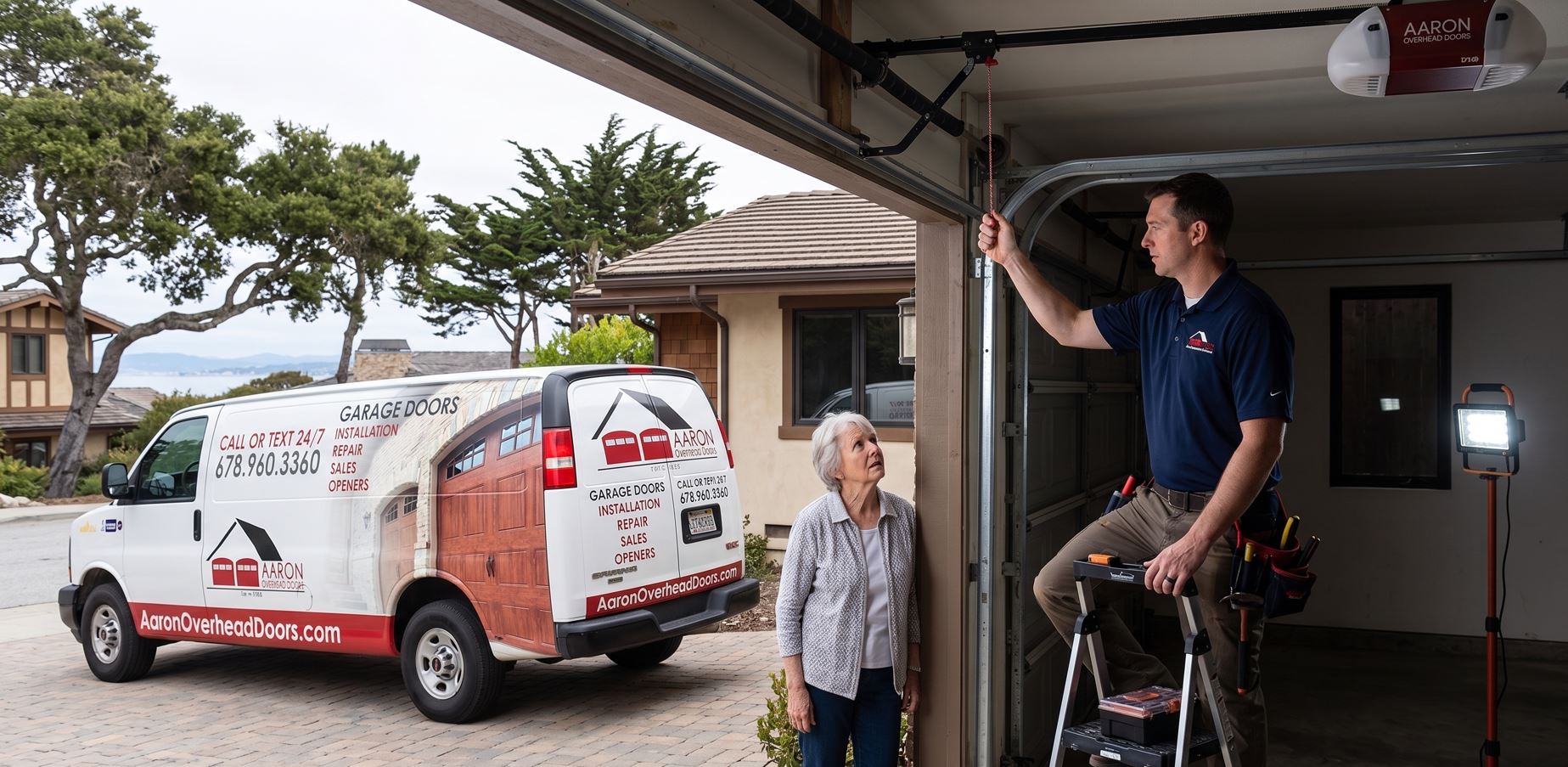
Garage door not opening? When the power goes out, your garage door isn't broken. Only the motor has stopped. The red emergency release lets you run the door by hand.
Pulling the cord is the easy part. Around Monterey Bay, people usually get stuck for other reasons. The springs can no longer hold the door's weight, salt air has seized the release, the backup battery died quietly, or the outage came with no warning.
Aaron Overhead Doors has been fixing these problems since 1968, and this guide covers each one.
The Quick Answer
- Close the door first. Use the release only when the door is fully down.
- Pull the red handle hanging from the opener rail straight down until the trolley lets go.
- Lift the door from the bottom with both hands. A healthy door feels light and stays put halfway up.
- Stop if it feels very heavy. A spring is probably broken. Leave the door closed and call us at 831-219-8648 . This is a potentially dangerous situation that could result in serious injury if you attempt to handle it yourself. For your safety, it’s best to leave it to a qualified professional who has the proper training and equipment.
- To reconnect, check the label on your opener for the correct direction, then press the wall button. The trolley should snap back on.
Opening the Door Safely
Keep the door closed before you pull the cord. If the door is open and a spring is weak, nothing holds it up once the opener is disconnected. It can fall hard. If your door is stuck open during an outage, leave it alone.
Unplug the opener during a long outage. Some guides say this keeps the motor from starting by itself when power returns. Openers don't do that. The real reason is the power surge that can hit when service comes back, which can damage the opener's circuit board.
Lift with your palms facing up at the bottom edge or the lift handle. Keep your fingers out of the gaps between panels. If the door drifts down when you let go, clamp locking pliers on the track under a roller before walking or driving under it.
Lock it when you're done. While the opener is disconnected, anyone can lift the door from outside, so use the manual slide lock if you have one. Unlock it before you reconnect the opener.
What the Law Says About the Red Handle
Federal rules (16 CFR Part 1211, based on the UL 325 safety standard) set three requirements for the emergency release:
- The handle must be red.
- It must be adjustable to hang 6 feet above the floor.
- It must release with no more than 50 pounds of pull, tested with the door closed.
This tells you two things. First, if someone shortened your cord to clear a roof rack and it's now out of reach, it won't help you in an emergency. Second, if a firm pull doesn't release it, something is wrong. Pulling harder is not the fix.
When the Red Cord Won't Release
This is one of the most common calls we get during outages. The usual causes:
- Salt corrosion. A small spring-loaded latch inside the trolley does the releasing. In coastal homes from Pacific Grove and Seaside up to Capitola and Santa Cruz, fog and salt air can rust it in place. Most people don't find out until the power is already out.
- Too much downward pressure. If the opener is set to push the door too hard into the floor, the latch jams under the load. That calls for an opener adjustment, not a harder pull.
- A broken or missing cord. Don't pry at the bottom seal or pull on the panels. Call a technician.
Salt air is also hard on springs. Rust creates weak spots where springs are more likely to break. A door with a broken spring can't be lifted safely, whether or not the release works.
Why Guides Disagree on Reconnecting
Search for how to reconnect a garage door opener and you'll find opposite answers. One popular guide says to pull the cord toward the door. Another says to pull it toward the motor. Both are describing real openers. The correct direction depends on your brand and model.
We service LiftMaster, Chamberlain, Genie and other major brands. For any of them, this works:
- Check the label near the release handle, or your owner's manual, for the correct direction.
- Close the door and unlock any manual lock.
- Set the release lever to its reconnect position.
- Press the wall button. The trolley will travel along the rail and click back onto the door arm.
If the motor runs but the door doesn't move, the trolley missed the arm. Reset the lever and try again.
Outages Here Don't Always Come With a Warning
PG&E's Public Safety Power Shutoffs usually come with advance notice. Parts of Monterey County, including Carmel Valley, were on shutoff lists as recently as July 2026.
The outages that catch people off guard are fast-trip outages. During fire season, PG&E sets some lines to shut off instantly when anything touches them, even a branch or a squirrel. In the 2024 fire season, there were 25 of these outages in the San Lorenzo Valley (Boulder Creek, Ben Lomond, Felton) and 12 around Corralitos and Watsonville.
Some lasted close to eight hours. Winter storms add more. In February 2025, some Boulder Creek homes were without power for five days.
The takeaway: don't wait for a shutoff alert to check your release or backup battery. Keep both ready year-round.
California's Battery Backup Law (SB 969)
Since July 1, 2019, every residential opener sold or installed in California must have a battery backup. Violations carry a $1,000 penalty per opener.
Two points most homeowners miss:
- Replacing only your door still triggers the law. A new door can't be connected to an older opener without battery backup. If we tell you the opener needs an upgrade when we install a new garage door, that's state law, not an upsell.
- Older openers are exempt. The law isn't retroactive, so many local homes still have pre-2019 openers with no battery at all.
The law was passed after the 2017 North Bay wildfires. People lost power during those fires and couldn't lift their garage doors to escape. The lesson: a manual release only helps if you can physically lift the door.
Test your backup battery
A typical backup battery handles about 20 open-and-close cycles per charge and lasts one to two years.
- Heat wears batteries out faster. Garages in warmer inland areas like Salinas, Hollister and Carmel Valley may need replacements sooner than garages on the coast.
- Frequent outages wear them out too. Homes on fast-trip-prone lines in the San Lorenzo Valley drain their batteries more often.
The 60-second test: Unplug the opener and press the wall button. If the door doesn't move, or moves slowly and stops, replace the battery. We install battery-backup LiftMaster and Chamberlain openers and replace batteries in existing units.
Wildfire and Earthquake Readiness
The 2020 CZU Lightning Complex fire forced about 77,000 people to evacuate and destroyed 925 homes in Santa Cruz County. CAL FIRE recommends parking in the driveway, facing out, when evacuation is possible.
On Red Flag Warning days:
- Park outside so a stuck door can't trap your car.
- Before fire season, lift the door by hand halfway and let go. If it doesn't stay put, or someone in your home can't lift it alone, schedule a spring repair or tune-up now.
After an earthquake: Before lifting the door, check that both tracks are straight, the door sits level, the cables are tight, and the spring has no gap. If anything looks off, leave the door closed. The 1989 Loma Prieta earthquake was centered in the Santa Cruz Mountains, and doors pulled off their tracks can fall when lifted.
If your garage is your only way in: An exterior emergency release lets you disconnect the opener from outside with a key. Ask us about adding one.
When to Call Aaron Overhead Door
Call us instead of forcing the door if:
- It feels very heavy or lifts unevenly.
- The cord pulls but the trolley won't release.
- The spring has a gap, or a cable is frayed.
- The door is off its track or stuck open.
- Your opener is from before 2019 and has no battery backup.
Our trucks are fully stocked, so most repairs are done the same day. We serve Monterey, Santa Cruz and San Benito counties from our shop at 121 Fairground Rd. in Monterey.
Call 831-219-8648 or contact us online with any questions.
FAQs
Here are the questions our techs get from homeowners from Monterey to Santa Cruz:
How do I open my garage door without power?
With the door closed, pull the red emergency release cord straight down. Then lift the door by hand from the bottom. If it feels very heavy, stop, because a spring is likely broken.
Why won't my garage door emergency release work?
Near the coast, salt corrosion often seizes the latch inside the trolley. An opener set to push the door too hard into the floor can also jam it. The release is designed to work with no more than 50 pounds of pull, so if a firm pull doesn't work, call a technician.
Which way do I pull the cord to reconnect my opener?
It depends on the brand and model. Check the label near the handle or your manual, set the lever to reconnect, and press the wall button.
Are battery backup garage door openers required in California?
Yes. Under SB 969, openers sold or installed since July 1, 2019 must have one. A new door also can't be connected to an older opener without a battery backup.
How long does a garage door opener backup battery last?
Usually one to two years, with about 20 cycles per charge. Heat and frequent outages shorten its life.