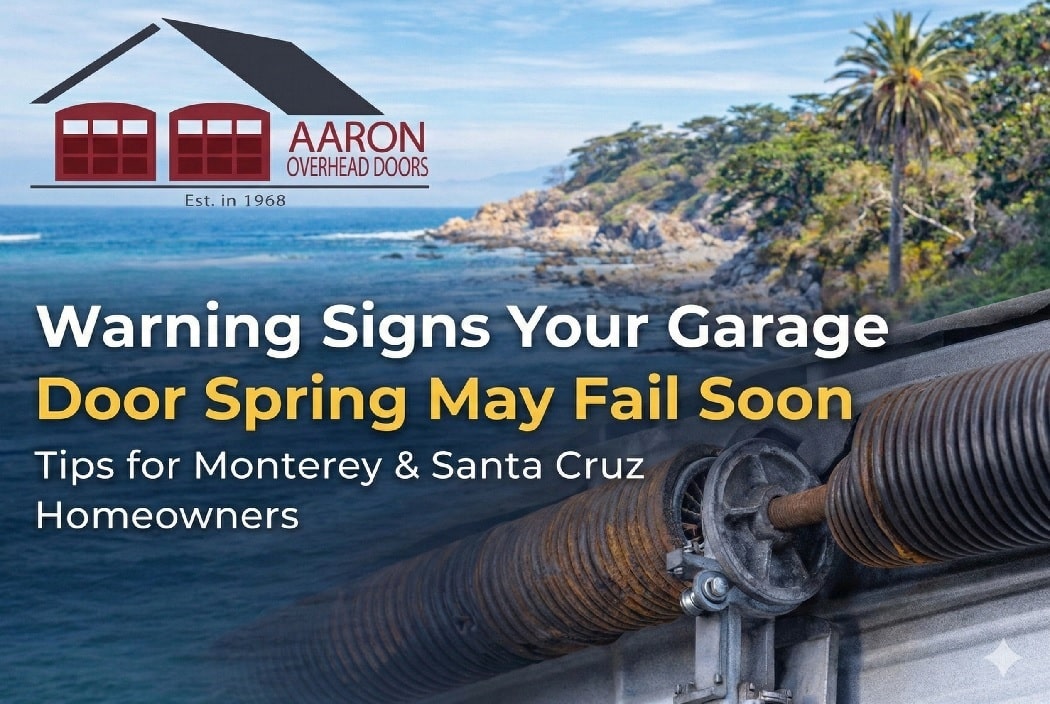
arage door spring failure is one of the most common, and most preventable, causes of emergency garage door repairs along California’s Central Coast. In coastal communities from Monterey to Santa Cruz, salt air corrosion and humidity accelerate spring wear compared to inland climates.
This guide will help you figure out what’s really going on. We’ll walk you through the early warning signs to watch for so you can catch small issues before they become expensive repairs. Clear advice to help you understand what’s happening and what steps to take next.
What Does a Garage Door Spring Actually Do?
A garage door spring counterbalances the weight of the door so your opener doesn’t carry the full load.
Most residential systems use either:
-
Torsion springs (mounted above the door on a torsion tube)
-
Extension springs (mounted along the horizontal tracks)
Torsion Spring System
Torsion store mechanical energy by twisting around a steel shaft. Components include:
-
Torsion tube
-
Cable drums
-
Lift cables
-
Center bearing plate
-
Winding cones
They provide smoother operation and longer cycle life but require specialized winding bars and training to adjust safely.
Extension Spring System
Extension springs stretch and contract along the horizontal track. They include:
-
Safety cables (required by code in California)
-
Pulleys
-
Eyebolts
These are less expensive but generally wear out faster and create more vibration.
Signs to Look Out For
1. Your Garage Door Feels Heavier Than Normal
If your garage door suddenly feels heavier when lifting manually, the spring is likely losing tension.
A properly balanced door should lift smoothly and stay halfway open when disconnected from the opener (using the emergency release cord). If it slams shut or drifts downward, the spring is no longer counterbalancing the door weight.
Risk: Continuing to operate the door can burn out the garage door opener motor or strip nylon drive gears.
2. You Hear a Loud Bang From the Garage
If you heard a sharp, gunshot-like sound in the garage, a torsion spring may have snapped.
When torsion springs break, stored torque releases instantly. Many homeowners in coastal areas mistake this for something falling inside the garage.
- Pro: A visible gap in the spring confirms failure.
- Con: Extension springs may not show a clear break and can still hang in place due to safety cables.
3. Visible Rust or Pitting on the Spring Coils
If you see rust flakes or surface pitting, corrosion is actively weakening the steel.
Salt-laden marine air in Carmel-by-the-Sea and coastal Pebble Beach accelerates oxidation. Rust increases friction between coils, causing uneven stress distribution and premature metal fatigue.
Pro Tip: Galvanized springs resist corrosion better than oil-tempered springs in coastal climates but they may have slightly shorter fatigue life under high-cycle usage. Choosing the right material matters more near the ocean.
4. The Door Opens Crooked or Jerky
If one side rises faster than the other, a spring may be unevenly tensioned or partially fractured.
This imbalance stresses:
-
Lift cables
-
End bearing plates
-
Garage door rollers
-
Hinges
Left unchecked, this can warp door panels or cause cable derailment from the drum.
5. The Door Only Opens a Few Inches
If your door opens 6–12 inches and stops, a broken torsion spring is likely.
Most modern openers include force-sensing technology. When the spring fails, the opener detects excessive load and stops to prevent motor damage.
Important: This is a mechanical issue, not an electrical one.
6. The Spring Is Over 7–10 Years Old
If your spring is over 10,000 cycles (roughly 7–10 years for most households), it is statistically near failure.
One “cycle” equals one full open and close. Homes where the garage serves as the primary entry point often exceed 1,500 cycles per year.
- Pro: Upgrading to 25,000+ high-cycle springs dramatically reduces emergency breakdown risk.
- Con: Higher cycle springs cost more upfront but cost less per cycle over time.
Coastal-Specific Failure Factor: Salt Air Microfractures
One issue rarely discussed in other blogs is microfracture formation caused by salt crystallization.
In coastal environments like Pacific Grove and Monterey:
-
Salt particles settle between spring coils.
-
Moisture accelerates corrosion at microscopic stress points.
-
Repeated torque cycles expand these fractures until catastrophic failure.
This explains why springs near the coast often fail 1–3 years earlier than manufacturer projections.
When Should You NOT Touch the Spring?
You should never attempt DIY torsion spring adjustments without proper winding bars and training.
Torsion systems store extreme rotational energy. Improper handling can result in:
-
Wrist fractures
-
Facial injury
-
Cable whip injuries
California building standards require safety containment measures for extension systems, but torsion systems rely on proper installation and torque calibration.
What You Can Do to Prevent Spring Failure
If you live within 2–3 miles of the ocean, apply a light garage-door-specific lubricant (not WD-40) to the spring coils every 3–4 months.
Use:
-
Silicone-based garage door lubricant
-
Or lithium-based spray rated for metal coil applications
Avoid:
-
Penetrating oils
-
Heavy grease
Regular lubrication reduces coil friction and slows corrosion, especially in humid marine climates.
Quick Diagnostic Checklist
Disconnect the opener and manually lift the door halfway.
The door is healthy if it:
-
Stays balanced mid-travel
-
Moves smoothly without jerking
-
Makes minimal noise
-
Shows no visible coil separation
Call for service if:
-
You see a 2–3 inch gap in the torsion spring
-
The door slams shut
-
Cables appear loose
-
Rust scaling is heavy
Should I Replace Before It Breaks?
Proactive replacement reduces emergency downtime and protects your opener.
Reactive replacement costs less upfront but increases risk of:
-
Secondary component damage
-
Emergency service calls
-
Vehicle entrapment
For Monterey-to-Santa-Cruz homeowners, coastal corrosion makes preventative maintenance more valuable than in inland climates.
Don’t Wait for a Snap!
A broken spring is a major safety hazard and a total inconvenience. If you see rust or hear straining, play it safe and call Aaron Overhead Doors at 831-219-8648 to schedule a professional safety inspection or contact us online with any questions.