


Larry Conte
Owner & Industry Expert, Aaron Overhead DoorsLarry Conte is an industry veteran with over 20 years of experience in garage door installation, repair, and custom design. As the operating leader of Aaron Overhead Doors in Monterey, CA, Larry is known by industry peers as "Larry Legend" for his high-quality craftsmanship and customer-first approach. Today, he shares his decades of expertise to help homeowners make safe, informed decisions about their garage doors.
What Actually Happens Internally When a Car Hits Your Garage Door
In the Central Coast, from the foggy reaches of Santa Cruz to the sun-drenched hills of Monterey, a garage door is a massive, tensioned machine acting as a primary barrier against Pacific salt air and coastal winds. When a vehicle makes contact with that door, even at 2 MPH, it’s not just a "dent." It is a kinetic event that triggers a mechanical chain reaction inside your garage.
The first thing you should not do is hit your remote (we’ll explain why below). Instead, take a moment to understand what’s actually happening behind that steel exterior and how it can impact the safety and performance of your garage door.
1. The Immediate Protocol
If you've hit your door, follow this exact sequence to prevent a costly scenario:
-
DO NOT touch the remote. This is the #1 cause of turning a $300 repair into a $3,500 replacement.
-
Inspect the Bottom Brackets. These are the metal plates at the very bottom corners where the cables attach. If they are bent or loose, step away. They are under enough tension to cause severe injury.
-
Check for Daylight. In Santa Cruz, if you see light at the edges, your track is misaligned. Close the gap with a tarp to keep the salt air out until a technician arrives.
-
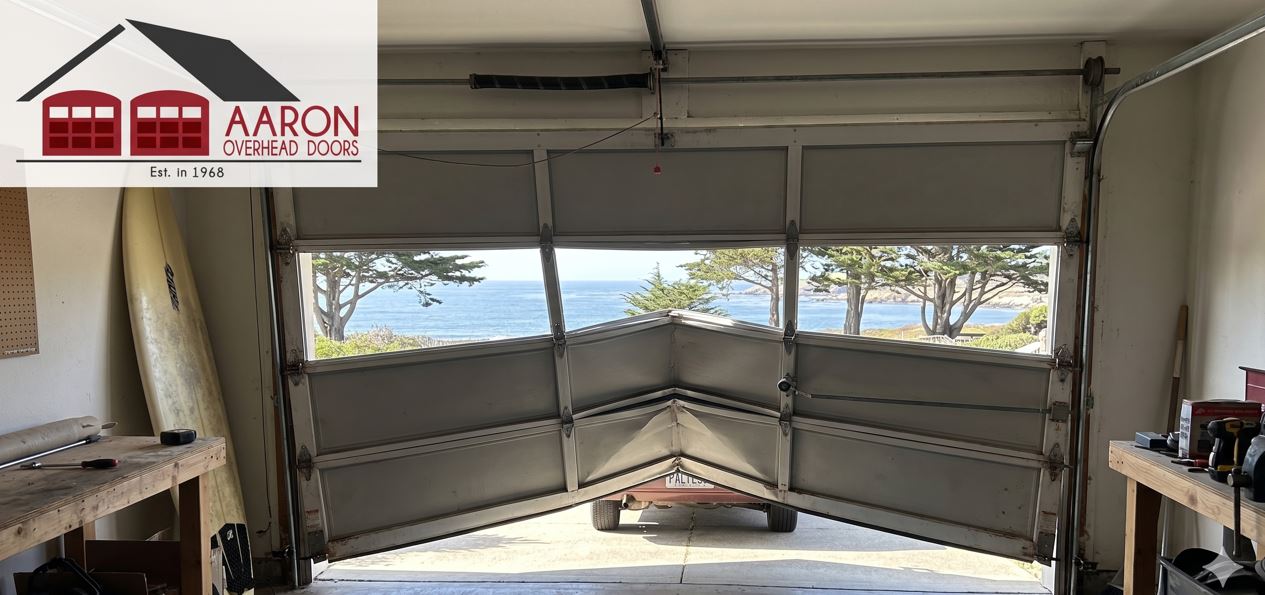
Photo-Document the Stiles. Take photos of the vertical metal ribs on the inside of the door. If these are buckled, the door has lost its structural integrity and could collapse under wind load.
Aaron Overhead Doors hasn't just fixed doors from Monterey to Santa Cruz since 1968; we understand the mechanical "why."
2. The Kinetic Chain: From Bumper to Bearing
When your bumper or car hits a panel, the energy doesn't stop at the dent.
-
The Sectional Fold: Most modern doors are made of 24-to-25-gauge steel. An impact causes the panel to "V-fold." This instantly shortens the horizontal width of the door, pulling the rollers inward.
-
Track Displacement: As the rollers are pulled inward, they exert lateral force on the vertical tracks. These tracks are often only held by lag screws into 2x4 wooden jambs. The impact can strip these screws or "mushroom" the track, making it impossible for the door to slide up or down.
-
The Torsion Shift: This is the "hidden" danger. Your door is balanced by a high-tension torsion spring. If the impact knocks the door off-center, the cables, which carry the full weight of the door, can jump off their drums. Once a cable is loose, the spring's energy is no longer controlled, turning the door into a dead weight that can weigh 200+ lbs.
3. The "Central Coast" Factor: Why Salt Air Changes the Stakes
In this region, a garage door's constant battle with corrosion determines its performance, longevity, and reliability.
-
Stress Corrosion Cracking: In Santa Cruz or Monterey, your hinges and rollers likely already have "white rust" (zinc oxidation) or red rust from the salt air.
-
The Brittle Point: Rust makes steel brittle. An impact that might only dent a door in an inland city like Fresno can cause a coastal door’s hinges to snap or its track brackets to shear off entirely.
-
The Seal Breach: A vehicle hit often compromises the bottom astragal (the rubber seal). This isn't just about aesthetics; a compromised seal allows salt-laden fog to enter your garage, accelerating the rusting of your car, tools, and the garage door opener's internal gears.
4. The Logic Board Stress of Your Opener
If you hit the "Close" button after an impact, the opener’s motor tries to force a bent door through a crooked track.
-
The Plastic Gear Strip: Most LiftMaster or Chamberlain openers use a nylon drive gear. When the door is stuck due to impact, the motor won't stop immediately; it will "chew" through its own internal gears until the plastic teeth are stripped bare.
-
The Force Limit Trigger: Modern openers have a "Force Profile." The impact changes the door's weight distribution, often "confusing" the opener's software, leading to a permanent error code that may require a full system reset or board replacement.
5. Assessing the Damage: Cosmetic vs. Structural
| Feature | Cosmetic (DIY-ish) | Structural (Pro Required) |
|---|---|---|
| Panel | DIY Friendly Surface scratch or light "ping" | Call a Pro The "V-Fold" or "crease" that touches the center stile |
| Rollers | DIY Friendly Seated firmly in the track | Call a Pro Hanging out of the track or tilted at 45° |
| Cables | DIY Friendly Taut and wrapped on the drum | Call a Pro Slack, bird-nested, or disconnected |
| Track | DIY Friendly Vertical and straight | Call a Pro Bowed outward or pulled away from the wall |
Whether you're dealing with a "slow-roll" bump in Pebble Beach or a significant impact in Salinas, the internal physics remain the same.
A garage door hit by a car is a system in distress, and treating it like a simple dent is the fastest way to compromise your home's safety and your wallet.
Get Emergency and Same Day Service When You Need It
Contact the local experts at Aaron Overhead Doors by calling 831-219-8648 or contact us online with any questions.
Standard parts will not survive our salt-air environment after the protective factory seal has been cracked by an impact.